On this page
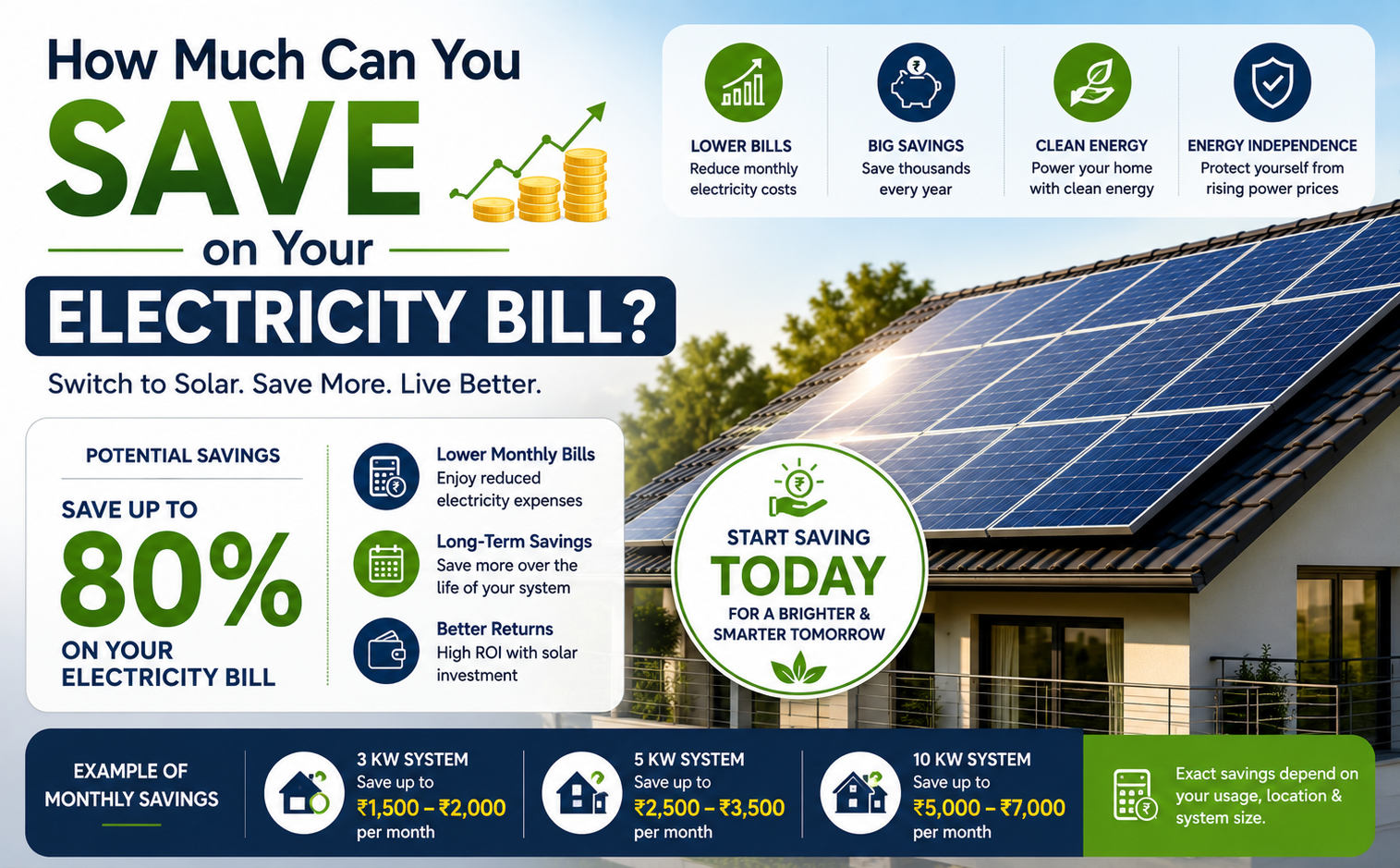
Most homes that go solar end up with a small fraction of the bill they used to pay. How much you save depends on three things: how many units you use, how your state charges for them, and how much sun reaches your roof. Here is how to work it out, with a real Hyderabad bill as the example, and what it adds up to over the life of the system.
If you'd like to know what the subsidy pays first, start with our PM Surya Ghar guide.
- Each kW of panels makes
- about 110 to 130 units a month
- 3 kW system, before subsidy
- roughly ₹1.65 to ₹2.10 lakh
- Subsidy for a home
- up to ₹78,000
- Typical payback
- about 3 to 5 years
Why solar saves more than you'd expect
Electricity in India is charged in slabs: the more units you use in a month, the more each unit costs. In Telangana, a home that uses more than 200 units a month moves into the top category, where every unit costs more, starting from the very first one.
Solar takes units off the top of your bill. So it doesn't just remove units, it removes the most expensive ones, and it can move your whole bill down into a cheaper category. That is why the saving is often bigger than the number of units alone would suggest.
How many units a system makes
In Hyderabad and Delhi, each kilowatt of panels makes about 4 units a day on average across the year, or roughly 110 to 130 units a month. Sunny months make more and monsoon months make less.
- 2 kW system
- About 240 units a month, or 2,800 to 3,100 a year.
- 3 kW system
- About 360 units a month, or 4,200 to 4,700 a year.
- 5 kW system
- About 600 units a month, or 7,000 to 7,800 a year.
A south-facing roof with no shade and panels kept clean will be at the top of these ranges. Shade from a water tank or a neighbouring building, or months of dust, will pull it down.
A Hyderabad bill, before and after
Take a family in Hyderabad using 400 units a month, which is common for a home with two air conditioners in summer. Here is the energy charge on their bill at TGSPDCL's current domestic rates, before and after a 3 kW system.
Before solar: 400 units
- First 200 units at ₹5.10
- ₹1,020
- Next 100 units at ₹7.70
- ₹770
- Next 100 units at ₹9.00
- ₹900
- Energy charge
- ₹2,690, plus 6% electricity duty and fixed charges: about ₹2,900 a month
With a 3 kW system: about 40 units net
- 40 units at ₹1.95
- ₹78
- With duty and fixed charges
- roughly ₹150 to ₹200 a month
That is a saving of around ₹2,700 a month, or more than ₹30,000 a year. Because the net units fall below 100, the bill drops from the most expensive category to the cheapest one.
A smaller home sees the same effect on a smaller scale. A family using 250 units a month pays about ₹1,400 in energy charges. A 2 kW system brings that close to nothing, a saving of about ₹16,000 a year.
In Delhi the slabs and surcharges are different, and homes using up to 200 units a month already get free power from the state. Solar pays off fastest there for homes with bigger bills. Delhi also adds its own subsidy on top of the central one, which our subsidy guide explains.
How long it takes to pay back
Payback is simply what the system costs you after the subsidy, divided by what it saves each year.
- 3 kW system
- Roughly ₹1.65 to ₹2.10 lakh installed.
- Less the subsidy
- ₹78,000, paid into your bank account after commissioning.
- What you pay
- About ₹87,000 to ₹1.32 lakh.
- Saving, for the 400-unit home above
- About ₹30,000 a year.
- Payback
- About 3 to 4½ years.
Homes with smaller bills save less each year, so their payback is longer, usually 4 to 6 years. In every case the panels go on working for 25 years or more, so most of the system's life is pure saving.
If you'd rather not pay upfront, the scheme's own bank loan for systems up to 3 kW is about 5.75% a year. Our subsidy guide explains how it works.
What it adds up to over the years
Panels lose a little output each year, about half a percent, so a system makes slightly less in year 20 than in year 1. Even allowing for that, the 400-unit home above would save:
- In 5 years
- about ₹1.5 lakh
- In 10 years
- about ₹2.9 lakh
- In 25 years
- about ₹7 lakh
- Paid for itself in
- about 4 years
These figures use today's tariffs. Electricity prices have tended to rise over time, and if they do, the savings will be larger. Set aside something for one inverter replacement during the system's life, usually after 10 to 12 years.
What happens to the extra units
With net metering, units your panels make and you don't use go to the grid, and the net meter counts them. They are first set against what you take from the grid at night and on cloudy days.
If you send out more than you use in a month, Telangana's rules pay for the surplus at a low rate, based on the cheapest solar power the state's DISCOMs have bought. That is far below what you pay for a unit. So a unit is worth most when it offsets your own use, and there is little point in a system much bigger than your need.
What cuts into your savings
- Shade from a water tank, a parapet, trees or a taller building next door, even for part of the day.
- Dust. Panels left uncleaned through a dry summer can lose a noticeable share of their output.
- A system that's too small for your use, so your bill stays in a high slab.
- A system that's much bigger than your use, so many units go out at a low rate.
- Panels laid flat on a hot slab instead of raised on a tilted structure, which makes them run hotter. Our panel guide explains why heat matters.
Sizing the system to your bill
The simplest way to size a system is from your own bills. Add up the units from your last twelve bills and divide by twelve to get your monthly average. Then allow about 120 units a month for each kilowatt.
- Around 150 units a month
- 1 to 1.5 kW
- Around 250 units a month
- 2 kW
- Around 350 to 400 units a month
- 3 kW
- Around 600 units a month
- 5 kW
The system can't be bigger than the sanctioned load on your bill, and the central subsidy stops rising at 3 kW. Put your monthly bill into our system size estimate for a quick suggestion.
How we help
The numbers above are a guide. Your own saving depends on your bills, your slab and your roof, so we work it out for your home before you decide anything.
- We read a year of your bills and work out your saving, slab by slab
- A free site survey to check shade, roof space and which way the roof faces
- A system sized to what you use, not the biggest one that fits
- Help with the subsidy and the net meter, then after-sales service and panel cleaning
Want to see your own numbers?
Send us a photo of your electricity bill. We'll tell you what size of system suits it, what it would cost after the subsidy and roughly what you'd save each year.
Questions people ask
Will my electricity bill become zero?
Rarely. Solar takes the units off your bill, but fixed and customer charges stay, because you are still connected to the grid. For a well-sized system, what is left is usually a small fraction of the old bill.
I am out at work all day. Do I still save?
Yes. With net metering, the units your panels make while you are out go to the grid and are counted against the units you use in the evening. You don't need to be home when the sun is shining.
Is the saving the same every month?
No. Panels make the most in the dry, sunny months and less during the monsoon, when days are cloudy. The figures in this guide are averages across the year.
Does solar keep the lights on during a power cut?
Not an ordinary on-grid system. It switches off when the grid goes down, so it doesn't send power into lines that people may be repairing. For backup you need batteries, which our on-grid and off-grid guide explains.
What does it cost to keep the system running?
Very little. Panels need regular cleaning, especially in dusty months, and a check now and then. Under PM Surya Ghar, the vendor maintains the system for the first five years. The inverter usually needs replacing once in the system's life.
What if electricity prices go up?
Then each unit your panels make is worth more, and your savings grow. Our figures use today's tariffs, so a future price rise would only shorten the payback.