
Lower upfront cost
A lower price per panel keeps the initial investment down, so the system pays for itself sooner.
P-type modules from 380 W to 560 W, in bifacial dual glass, monofacial and transparent backsheet versions. A reliable, budget-friendly choice, especially where roof space is not tight.
P-type is the long-established cell technology behind most of the world's installed solar. Here is why it still makes sense.
A lower price per panel keeps the initial investment down, so the system pays for itself sooner.
Years of large-scale use behind it, with long power warranties of 25 to 30 years.
Where space is not tight, a few more panels deliver the power you need at a better overall price.
Bifacial dual glass, monofacial or transparent backsheet, in four sizes each, to suit the roof and budget.
Two of our three P-type lines are bifacial: the dual glass and the transparent backsheet modules. Their rear side is open to light, so they add power a single-sided panel would miss.
Every line, side by side. Tap a name to jump to its models and datasheets.
Swipe the table to see all three lines
| Feature | M10 / G12 cells · dual glassBifacial dual glass | M10 cells · monofacialMonofacial | M10 cells · clear backsheetTransparent backsheet |
|---|---|---|---|
| Build | Dual glass | Monofacial, single-sided | Glass front, transparent backsheet |
| Cell size | M10 (182 mm) or G12 (210 mm) | M10 (182 mm), gallium-doped | M10 (182 mm) |
| Front glass | 2 mm ARC-coated | Ask us | About 3.2 mm ARC-coated |
| Power from the rear | Yes, bifacial | No | Yes, about 5–30% extra |
| Bifaciality | Ask us | Not applicable | Up to about 70 ±10% |
| Busbars | 10 and 12, half-cut | Ask us | Ask us |
| Degradation | Below 2.0% in year one, then 0.45% a year | Ask us | Ask us |
| Power warranty | 30 years | 25 years | Ask us |
| Power range | 380–560 W | 385–555 W | 385–555 W |
| Models | 4 | 4 | 4 |
| Best for | Long life and the best warranty | Lowest cost, flush-mounted roofs | Bifacial gains at a lower weight |
“Ask us” means the figure is not published yet. We will confirm it with your quote, or you can check the model datasheet.
Pick a line to see its features, every model and the datasheet downloads.
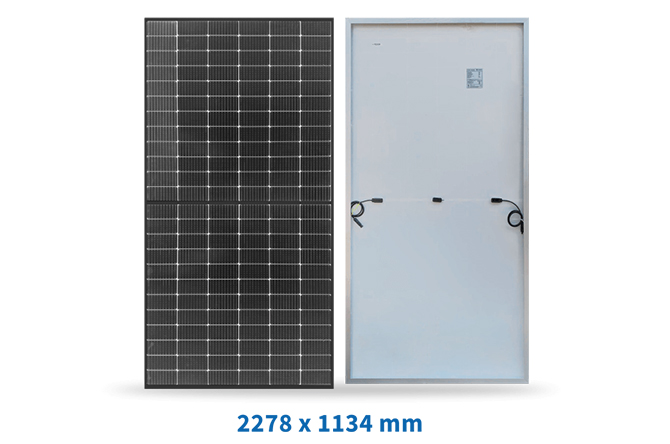
Supplied and installed by our own team, with a free site survey first.
Glass on both faces for a tough, weather-proof module that also turns light reflected off the roof or ground into extra power. The longest warranty in our P-type range.
| Model | Power output | Datasheet |
|---|---|---|
| 144-cell module | 530–560 W | Download PDF |
| 132-cell module | 485–515 W | Download PDF |
| 120-cell module | 435–460 W | Download PDF |
| 108-cell module | 380–410 W | Download PDF |
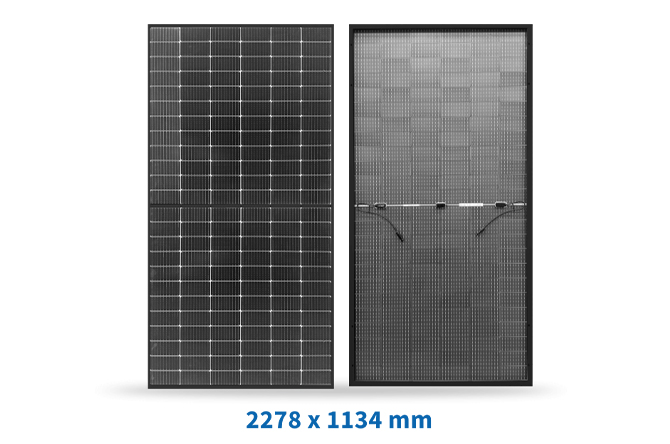
Supplied and installed by our own team, with a free site survey first.
A straightforward single-sided module with gallium-doped cells. Good value for rooftops where the panels sit close to the surface and little light reaches the back.
| Model | Power output | Datasheet |
|---|---|---|
| 144-cell module | 515–555 W | Download PDF |
| 132-cell module | 490–510 W | Download PDF |
| 120-cell module | 425–460 W | Download PDF |
| 108-cell module | 385–415 W | Download PDF |
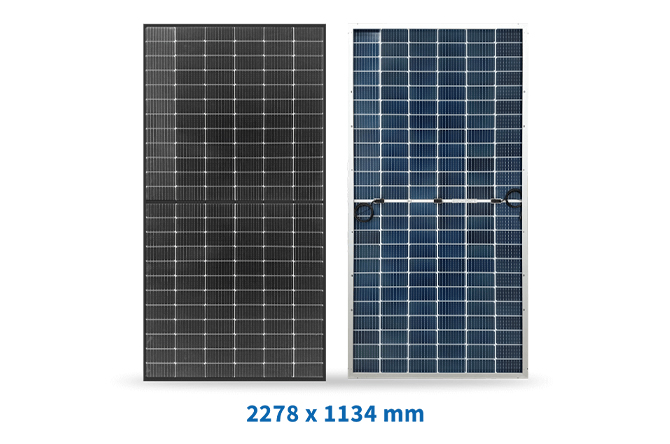
Supplied and installed by our own team, with a free site survey first.
A clear backsheet keeps the module lighter than dual glass while still collecting light from the rear, so you get bifacial gains at a lower weight.
| Model | Power output | Datasheet |
|---|---|---|
| 144-cell module | 525–555 W | Download PDF |
| 132-cell module | 485–510 W | Download PDF |
| 120-cell module | 435–460 W | Download PDF |
| 108-cell module | 385–415 W | Download PDF |
A rough guide. After the free site survey we recommend the exact model for your space, shade and budget.
108-cell modules are smaller and lighter, easy to fit around tanks and parapets on home terraces.
120-cell modules balance size and output for typical independent houses and villas.
132-cell modules mean fewer panels on bigger terraces and small commercial roofs.
144-cell modules suit open roofs on offices, warehouses and factories.
Short on roof space, or want the most output per panel? Have a look at N-type.
P-type is the long-established solar cell technology used in most solar installed to date. It is proven and reliable, and it usually costs less up front than newer N-type panels.
Bifacial panels also produce power from light reflected onto their rear side, roughly 5–30% extra on our transparent backsheet modules, depending on the surface below. Monofacial panels are single-sided and cost less, and they suit panels mounted close to the roof, where little light reaches the back.
The bifacial dual glass line carries a 30-year power warranty and the monofacial line a 25-year power output warranty. For the transparent backsheet line, we confirm the warranty terms with your quote.
Choose P-type if you want a lower upfront cost and have room for a few more panels. N-type gives more output per square metre and ages more slowly. See our N-type range or ask us to compare both for your roof.
Yes. Our own team designs and installs every system, after a free site survey. We work from offices in Hyderabad and New Delhi. Call 9705 9705 45 to book one.