
More energy
Higher cell efficiency means more units from the same roof area, and more savings on every bill.
Bifacial N-type TOPCon modules from 405 W to 710 W. They lose less output in the heat, age more slowly and keep producing for decades.
N-type TOPCon is the newer cell technology. Here is what it means on your roof.
Higher cell efficiency means more units from the same roof area, and more savings on every bill.
Bifacial modules also catch light bouncing off the roof or ground, adding yield from the rear face.
At 0.40% a year after year one, the panels keep far more of their output across a 25 to 30-year life.
Half-cut, multi-busbar cells and anti-PID materials reduce losses from shading, heat and voltage stress.
All three of our N-type lines are bifacial. The rear of each module is open to light, so it adds power the front alone would miss.
Every line, side by side. Tap a name to jump to its models and datasheets.
Swipe the table to see all three lines
| Feature | M10 cells · dual glassDual glass, M10 | M10 cells · clear backsheetTransparent backsheet | G12 cells · dual glassDual glass, G12 |
|---|---|---|---|
| Build | Dual glass | Glass front, transparent backsheet | Dual glass |
| Cell size | M10 (182 mm) or G12 (210 mm) | M10 (182 mm) | G12 (210 mm) |
| Front glass | 2 mm ARC-coated | 3.2 mm low-iron tempered | 2 mm ARC-coated |
| Bifaciality | Up to 80 ±10% | Up to 80 ±10% | Up to 80 ±5% |
| Busbars | 10 and 12, half-cut | 10, half-cut | 18, half-cut |
| Degradation | 0.40% a year | Below 1.0% in year one | Below 1.0% in year one, then 0.40% a year |
| Power warranty | 30 years | Ask us | 30 years |
| Power range | 405–590 W | 405–590 W | 680–710 W |
| Models | 3 | 4 | 1 |
| Best for | Homes and businesses wanting long life | Most homes, with the widest size choice | Large commercial roofs and ground-mount |
“Ask us” means the figure is not published yet. We will confirm it with your quote, or you can check the model datasheet.
Pick a line to see its features, every model and the datasheet downloads.
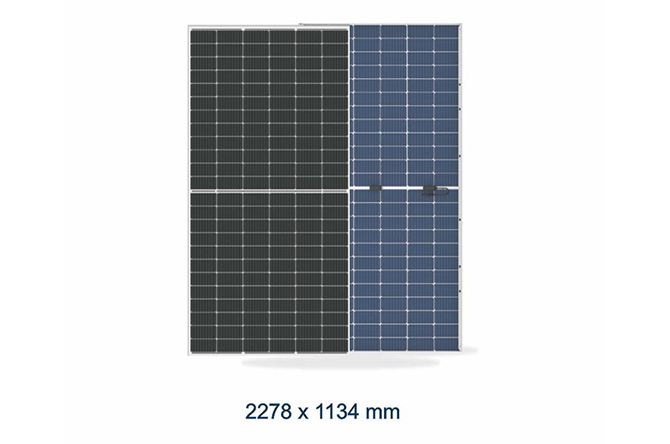
Supplied and installed by our own team, with a free site survey first.
Glass on both faces protects the cells and lets the rear side capture light reflected off the roof or ground, for a tough, long-lived module.
| Model | Power output | Datasheet |
|---|---|---|
| 144-cell TOPCon module | 560–590 W | Ask for datasheet |
| 120-cell TOPCon module | 440–465 W | Download PDF |
| 108-cell TOPCon module | 405–425 W | Download PDF |
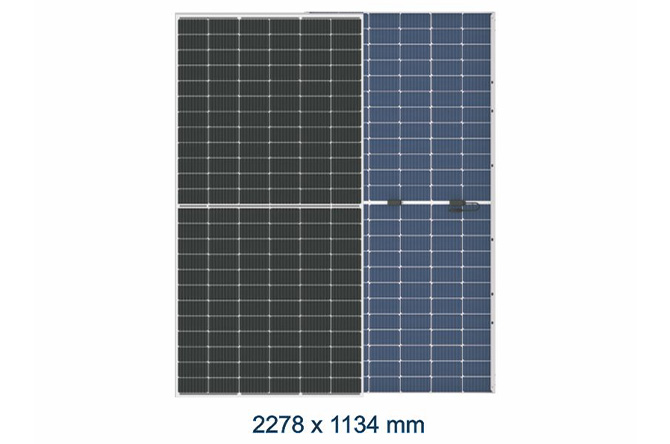
Supplied and installed by our own team, with a free site survey first.
A clear backsheet keeps the module lighter than dual glass while still collecting light from the rear, with the widest choice of sizes in the range.
| Model | Power output | Datasheet |
|---|---|---|
| 144-cell TOPCon module | 560–590 W | Download PDF |
| 132-cell TOPCon module | 490–520 W | Download PDF |
| 120-cell TOPCon module | 440–465 W | Download PDF |
| 108-cell TOPCon module | 405–420 W | Download PDF |
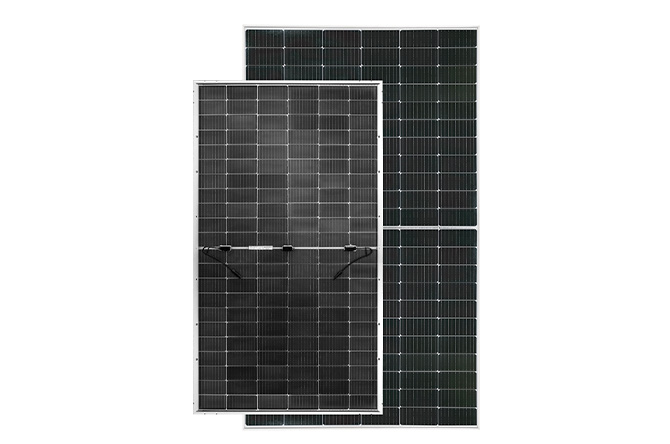
Supplied and installed by our own team, with a free site survey first.
Large G12 cells push each module past 700 W, so big rooftops and ground-mounted plants need fewer panels, less racking and less wiring.
| Model | Power output | Datasheet |
|---|---|---|
| 132-cell TOPCon module | 680–710 W | Download PDF |
A rough guide. After the free site survey we recommend the exact model for your space, shade and budget.
108-cell modules are smaller and lighter, easy to fit around tanks and parapets on home terraces.
120-cell modules balance size and output for typical independent houses and villas.
132 and 144-cell modules mean fewer panels on big, open roofs, offices and warehouses.
G12 modules suit factories and open land, cutting racking and wiring per kilowatt.
Working to a tighter budget? Have a look at P-type.
It is a newer type of solar cell. Compared with older P-type cells, N-type TOPCon cells convert more of the sunlight into power, lose less output in hot weather and age more slowly. On our range that means about 0.40% degradation a year after the first year.
Yes, as long as some light can reach the back of the panel. The gain depends on how reflective the surface underneath is and how high the panels are mounted. Light-coloured roofs and raised structures help most. We check this during the free site survey.
The dual glass M10 and G12 lines carry a 30-year power warranty. For the transparent backsheet line, we confirm the warranty terms with your quote.
Choose N-type if roof space is limited or you want the most output and the slowest ageing. P-type costs less up front and works well on larger roofs. See our P-type range or ask us to compare both for your roof.
Yes. Our own team designs and installs every system, after a free site survey. We work from offices in Hyderabad and New Delhi. Call 9705 9705 45 to book one.